Renewable Energy Storage
Green Chemistry Stationary Battery
The Edison Nickel Iron Cell
Outlasts Lead Acid by Decades!
Lasting Energy Storage for
Solar, Wind & Micro-Hydro
Invented over 100 years ago by Thomas Edison
as a non-polluting and non-consumable alternative
to Lead Acid Batteries using no heavy metals!
-Now manufactured once again worldwide after lead acid battery
companies closed Edison's Plant in 1972 in East Orange, NJ USA.
This Information Is Provided by ...
The Nickel Iron Battery Association

Thomas Edison with his Nickel
Iron Battery in 1910
Building a solar, wind or other renewable
energy system for a home or business can be discouraging if lead
acid batteries need to be used. Lead acid batteries
are "consumables" and last only a fraction of lifespan of your
solar panels or other electricity sources. Massive
battery banks of lead acid batteries need to be replaced every
10 years or less. However a better solution has been
available since about 1911 using the almost forgotten storage
battery that contains no toxic heavy metals and may outlast you
or your house!
The purpose of this site is to collect information that will help
people to use and maintain the Nickel Iron Battery technology for
use in Solar homes and for Marine applications. The
Nickel Iron battery often lasts in excess of 40 years and makes a
perfect match for solar panels which also last for about 40 years
or more. This site is focused on the re-popularization
of nickel iron batteries in renewable energy
applications. Nickel Iron Batteries contain no
environmentally damaging heavy or poisonous elements.
The electrolyte of Potassium Hydroxide is caustic but can be
useful in farming when diluted to neutralize acidic soils.
This site is not specific to a manufacturer or supplier.
Nickel Iron battery manufacturers or suppliers are welcome to list
links to their websites. This site supplies useful and
accurate information on the Edison Nickel Iron Battery technology
and its uses in alternate energy applications.
Nickel-iron
Battery Specifications
| Energy/weight |
30-50Wh/kg |
| Energy/size |
30
Wh/l |
| Power/weight |
100W/kg |
| Charge/discharge efficiency |
65% - 85% |
| Energy/consumer-price |
1.5–
6.6Wh/US$ |
| Self-discharge rate |
10-15%
/month |
| Time durability |
30–
100 years |
| Cycle durability |
Repeated deep discharge does not reduce
life significantly. |
| Nominal cell voltage |
1.2 V |
| Charge temperature interval |
min.-40°C
max.46 °C |
The nickel-iron battery (NiFe battery)
is a storage battery having a nickel(III)
oxide-hydroxide cathode
and an iron
anode,
with an electrolyte of potassium hydroxide. The active
materials are held in nickel-plated steel tubes or perforated
pockets. It is a very robust battery which is tolerant of abuse,
(overcharge, overdischarge, and short-circuiting) and can have
very long life even if so treated. [6]
It is often used in backup situations where it can be continuously
charged and can last for more than 40 years. Due
to its high cost of manufacture, other types of rechargeable
batteries have displaced the nickel-iron battery in most
applications. Because of their long life NiFe batteries are
ideal for backing up renewable energy applications. The
reason for their disappearance in the North American market is
largely due to the Exide Corporation's decision to abandon the
technology in 1975 after purchasing it from the Edison Storage
Battery company for several million dollars. The
reason for acquiring the manufacturing process to make NiFe
batteries and then simply abandoning the technology is
unknown. Exide remains the second largest manufacturer
of lead acid batteries in the world.
| (If anyone knows more about why Nickel Iron batteries went
out of production in North America please contact us and we
will update this website.) |
Charging Parameters
The proper float voltage is 1.45 volts per cell.
If
10 cells were used, the proper charge voltage would be 14.5
volts.
The
charge voltage can vary from 1.46 to 1.55 volts per cell. Unlike other battery designs,
the exact charge voltage is unimportant. A higher voltage
will result in quicker charges but more water loss that will
necessitate more frequent topping up with distilled water.
Since the cells can withstand overcharge there is
debate over what constitutes a proper charge voltage.
The higher you go the quicker water will disappear from the
batteries. At voltages greater than 1.5 volts/cell the
batteries will store approximately 15% more power than they are
rated for. If 10 cells were used, the charge voltage
could range from 14.6 volts to 15.5 volts. It is
probably better to use the 1.46 volts / cell level of charge in
order to minimize water loss if the battery will be unattended for
months at a time. Regenerative catalytic caps are
available to combine the h2 and o2 back into water if unattended
maintenance is required. There are also auto watering
systems that are available.
7
The
proper equalization voltage is 1.65 volts per cell.
If
10 cells were used, the proper equalization voltage would be 16.5
volts. This equalization charge is applied for 8 hours using
at least C/10 current. According to Edison's original
manual from 1914, it is best to completely discharge the batteries
from time to time before applying the equalization
charge. Edison also recommends a 1.7 volt equalization
charge and he recommends changing the electrolyte every 5-10
years.
This will all come as a surprise for lead acid battery
users. In contrast to lead acid, the NiFe battery can
be overcharged for decades at a time without damage and can be
left discharged for years at a time and will still work perfectly
when needed.
Durability
The ability of these batteries to
survive frequent cycling is due to the low solubility of the
reactants in the electrolyte. The formation of metallic iron
during charge is slow because of the low solubility of the Fe3O4.
While the slow formation of iron crystals preserves the
electrodes, it also limits the high rate performance: these cells
charge slowly, and are only able to discharge slowly. [6]
Nickel-iron cells should not be charged from a constant voltage
supply since they can be damaged by thermal runaway; the cell
internal voltage drops as gassing begins, raising temperature,
which increases current drawn and so further increases gassing and
temperature.
Nickel-iron batteries have long been
used in European mining operations because of their ability to
withstand vibrations, high temperatures and other physical stress.
They are being examined again for use in wind and solar power
systems and for modern electric vehicle applications.
Electrochemistry
The half-cell reaction at the cathode:
- 2 NiOOH + 2 H2O + 2 e− ↔ 2 Ni(OH)2
+ 2 OH−
and at the anode:
- Fe + 2 OH− ↔ Fe(OH)2 + 2 e−
(Discharging is read left to right,
charging is from right to left.)[7]
The open-circuit voltage is 1.4 volts,
dropping to 1.2 volts during discharge. [6]
The electrolyte mixture of potassium hydroxide and lithium
hydroxide is not consumed in charging or discharging, so unlike a
lead-acid battery the electrolyte specific gravity does not
indicate state of charge. [6]
Lithium hydroxide improves the performance of the cell. the
voltage required to charge the cells is between 1.6 and 1.7
volts. Most people use 1.65 volts.
History
Swedish inventor Waldemar
Jungner had invented the nickel-cadmium battery in
1899. Jungner experimented with substituting iron for the cadmium
in varying proportions, including 100% iron. Jungner had already
discovered that the main advantage over the nickel-cadmium
chemistry was cost, but due to the poorer efficiency of the
charging reaction, Jungner never patented the iron version of his
battery.
The nickel iron battery was developed
by Thomas Edison in 1901, and used as the
energy source for electric vehicles, such as the Detroit Electric and Baker Electric. Edison claimed
the nickel-iron design to be, "far superior to batteries using
lead plates and acid" (lead-acid battery).
Both
Edison
and Ford worked together on electric cars prior to the World War
One.
Jungner's work was largely unknown in
the US until the 1940s, when nickel-cadmium batteries went into
production there. A 50 volt nickel-iron battery was the main power
supply in the World War II German V2 rocket (together with two 16 volt
accumulators which powered the four gyroscopes),
with
a
smaller version used in the V1 flying bomb. (viz. 1946
Operation Backfire blueprints.)
1912
Detroit
Electric
Car with NiFe Battery
Several early car manufacturers
offered nickel iron batteries at the turn of the 20th century. NiFe batteries were
a more expensive option and most of these cars owned by
collectors such as Jay Leno still contain functioning NiFe
storage batteries constructed prior to World War One.
The Royal BC Museum in Canada
contains a working car as does the BC Hydro museum.
Nickel Iron Battery Still
Functioning after almost 100 years
Manufacturing from 1903
Edison's batteries were made from
about 1903 to 1972 by the Edison Battery Storage Company located
in East Orange, NJ. They were quite profitable for the company. In
1972 the battery company was sold to the Exide Battery
Corporation, which discontinued making the battery in
1975. The Eagle-Picher Company of the UK advertised in
1970 a nickel iron car battery that would "last as long as all the
cars you own in a lifetime". They purchased the cells for
their battery from Edison's company. They also
proposed their application in all electric vehicles in the early
1990s. Perhaps this was the stimulus to bury the Edison
Storage Battery Company. No one really knows why the
Exide Battery Company killed the technology in North America by
1975.
It is interesting to note that all
railways from 1910 to 1965 or so used nickel iron batteries in the
caboose to run all the lights on the train. Yet technical
literature on batteries such as Audel's New Electric Library only
mention lead acid batteries starting in 1945. It is even
erased in Audel's guide from the section on the history of
batteries. So it would appear that nickel iron battery
knowledge was no longer being published in technical guildebooks
by the end of the second world war. Yet V2
rockets during the second world war were nickel iron battery
powered. The reason for this disappearance from the
technical literature is a mystery.
Edison was disappointed that his
battery was not adopted for starting internal combustion engines
and that electric vehicles went out of production only a few years
after his battery was introduced. He actually developed the
battery to be the battery of choice for electric vehicles which
were the preferred transportation mode in the early 1900s
(followed by gasoline and steam). Edison's batteries had a
significantly higher energy density than the lead acid batteries
in use at the time, and could be charged in half the time, however
they performed poorly at low ambient temperatures. The
battery enjoyed wide use for railroad signalling, fork lift, and
standby power applications. By simply changing the
electrolyte to a higher concentration of KOH the modern
manufacturers have achieved low temperature operation.
In situations where a lead acid uncharged battery might suffer
freezing damage, a nickel iron battery will not be damaged at all.
There are now USA, Chinese and
Russian manufacturers of NiFe batteries. Nickel-iron cells
are currently made with capacities from 5 Ah to 1000 Ah. Many of
the original manufacturers no longer make nickel iron cells but
new manufacturers started appearing in the last 20 years.
Environmental
impact
Nickel-iron batteries do not have the
lead or cadmium of the lead-acid and nickel-cadmium batteries,
which makes them a lesser burden on human and ecological health. There are in
use for solar homes today mainly in Australia.
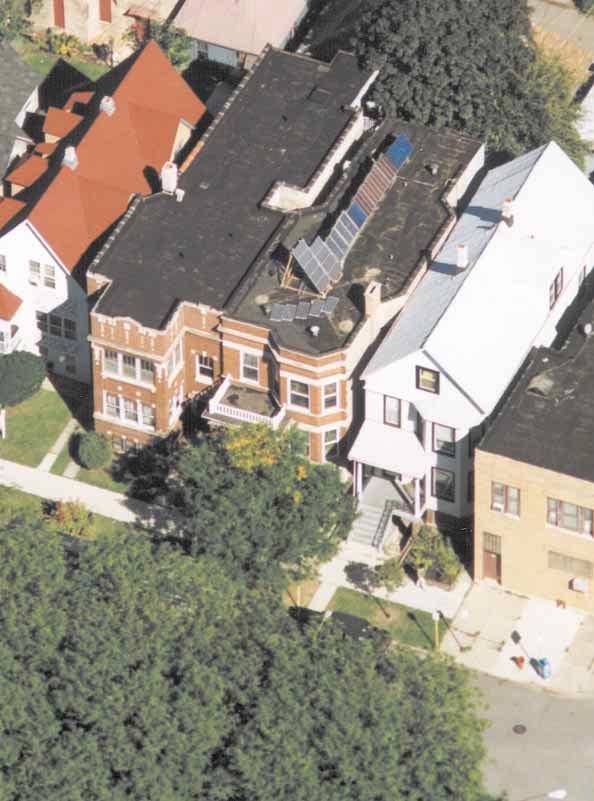
Example Chicago USA Off Grid
with Nickel Iron Batteries
(some from 1930s
and still ticking!)
Click to Read Report
Example
Canadian
Solar
Home with Nickel Iron Storage

 700 Watts of Solar Panels
200
Amp
Hour Nickel Iron Cell
700 Watts of Solar Panels
200
Amp
Hour Nickel Iron Cell
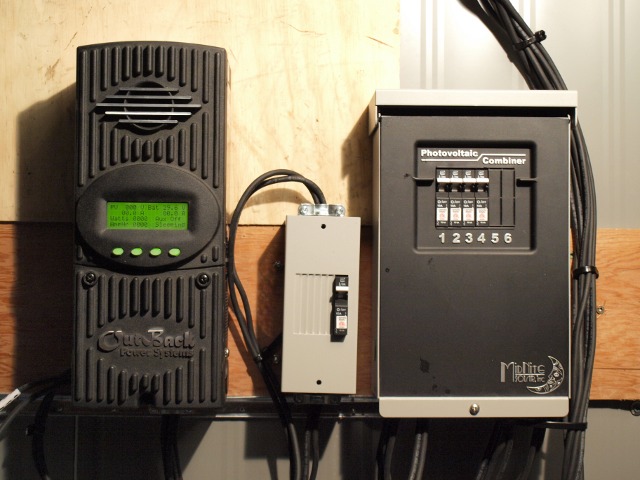

Maximum Power Point Controller set to Nickel Iron
Nickel Iron Battery Bank in Garden Shed
Remote Village Power in China
Project costs are much lower with
NiFe as compared to lead acid battery systems
when you take into account the
replacement of spent batteries. NiFe cells
will last 20-40 years in
this application. even with deep discharges.


Historic Technical Literature
on NiFe Batteries
1/ Edison published a nickel iron
maintenance guidebook in 1914 ... click here to download his
manual.
2/ Eagle-Picher advertsement for
their Nickel Iron car and Electric Car batteries.
Current Research on Nickel
Iron Batteries
The University of Michigan and the University of Victoria are
doing research on the application of Nickel Iron
Batteries. The University of Victoria is doing
research on the use of magneto-hydrodynamic (magnetic agitation)
processes to increase the efficiency into the 90% range for NiFe
batteries through the work of Dr. Robert
O'Brien. The University of Michigan is doing
research on the local manufacturing of NiFe batteries in
developing countries because of the environmentally friendly
chemistry. The results of these research projects
will be reported here during 2010.
Modern Research to
Rejuvenate 85 Year Old Edison Cells
Thomas Edison suggested that his Nickel Iron Cells would last
100 years. A battery researcher in the USA has
recently during 2011 rejuvenated some 85 year old cells produced
by Edison. He was able to restore them to a
useable state even after 85 years ... so it would seem it was
not an idle boast of Edison's that they would reach 100 years!
Here is the research paper to right click and save ...
Rejuvenating
an
85
year old battery pdf.
Open Source Concepts
for Future Research on the Edison Cell
1/ Storing the Hydrogen
Another new area that a number of people are working on is the
re-design of the Nickel Iron battery case so that the hydrogen
generated during the charging of a nickel iron battery can be
collected and saved for cooking, lighting or fuel cell operation
to generate electricity from the stored hydrogen. Thus the
generation of hydrogen during charging can become an asset.
This was Ian Soutar of Microsec R&D Inc.'s idea originally
and
is
being published here as a "public disclosure" to prevent the
possibility of anyone patenting the concept. These few
paragraphs constitute the first public disclosure.
Nickel Iron batteries are based on a Potassium Hydroxide (KOH)
solution for the electrolyte. Hydrogen generators
that are commercially avaiable also use a KOH solution and
nickel or stainless steel electrodes. Thus the Edison cell
almost certainly could be able to double as a hydrogen generator
as well! Anyone is free to fly with this idea ... as long
as they realize that this concept is now in the public domain
and will not be patentable. If anyone can
master it this will be a great breakthrough that can provide for
reliable and limitless decentralized local storage of
electricity. The Nickel Iron battery can be overcharged
for decades without damage as it merrily bubbles out its
hydrogen. We only need to figure out how to
collect it without affecting the battery function.
-Ian Soutar of Victoria BC Canada holds the copyright (Sept
2009)) for these ideas to be distributed for free public use
subject to the restrictions of the GPL3.
2/ Stopping the Generation of
Hydrogen
Microsec R&D Inc. is also doing research in Victoria BC
Canada on the use of catalytic caps (containing platinum wool)
for the battery cells that recombine the hydrogen and oxygen
released during charging into water and allows it to drip back
down into the cells. This may eliminate
the need to water the batteries regularly. These
caps are available for lead acid batteries but have a short
lifespan due to the sulphur present in the sulphuric acid
electrolyte. However the Nickel Iron chemistry
contains no poisons for the platinum catalyst and they might
last indefinitely with NiFe.
If this works
it would open the way to manufacture sealed nickel iron
batteries.
Attempts to create sealed Nickel Iron Batteries have so far not
been found due to the release of hydrogen. This is the
first public disclosure of the concept and it is open to
everyone to play with without patenting issues holding back the
research. This application would preclude the
collection of hydrogen of course.
-Ian Soutar of Victoria BC Canada holds the copyright (April
2010) for these ideas to be distributed for free public use
subject to the restrictions of the GPL3.
These concepts are presented in the spirit of the General
Public Licence or GPL3 that is usually applied to software.
Below is a link to the licencing concept to be used for the
above ideas.
http://www.gnu.org/licenses/gpl-3.0.html
Everyone is encouraged to add to this collection of research
ideas for the improvement of the Edison Cell.
The reason for
this public disclosure is evident in the new Lithium Iron
Phosphate batteries, where the chemical patent is owned by
A123Systems (http://www.a123systems.com/). The
ownership of this amazing chemical invention remains locked into
ownership by one group and the result is a very expensive
battery that will remain expensive for 20 years.
This inhibits the adoption of alternate energy technologies at a
time when their adoption is critical.
Nickel Iron Battery Supplier Homepages
www.changhongbatteries.com
Changhong Battery Manufacturer in China
http://www.beutilityfree.com
USA supplier of NiFe batteries
http://www.zappworks.com/
USA manufacturer and
supplier of NiFe batteries in Montana
http://IronEdison.com
USA Supplier of NiFe battery systems, Resource for historical
information
http://www.microsec.net
Canadian
Supplier
of ChangHong batteries, Victoria BC
http://www.agofuelcells.com
AGO Environmental Electronics in Canada (custom orders,
also sells hydrogen fuel cells)
http://www.accumkursk.ru
Kursk
Accumulator
Plant NiFe Manufacturer in Russia

Small Sized NiFe
Samples 10AH @ 1.2 volts
(for Educational and Industrial Battery Researchers)
Newly manufactured samples of
nickel iron cells nominally 1.2 (one point two volts)
available for $50 each including shipping within North America
to researchers. This service is being offered only to battery
researchers. Charging and maintenance instructions
shipped with each and technical assistance is available.
Please write to Ian Soutar of
Microsec R&D Inc ...
isoutar@microsec.net
External Links
http://en.wikipedia.org/wiki/Nickel-iron_battery
Wikipedia Article on NiFe Batteries
Hosted by the Nickel-Iron
Battery Association
Open to all Nickel Iron battery manufacturers and
suppliers worldwide.
There is no charge to post your
commercial NiFe supply webpage.
-we are looking for modern NiFe battery research links ... we can
post your research results.
To join email
isoutar@microsec.net